If you are deciding
Meeting outcomes are on the record with a named owner, which is what an auditor asks for when a decision is questioned.
If you use it daily
The summary is drafted for you and bound to the right organization and engagement. You settle what it assumed and attach it.
If you are doing diligence
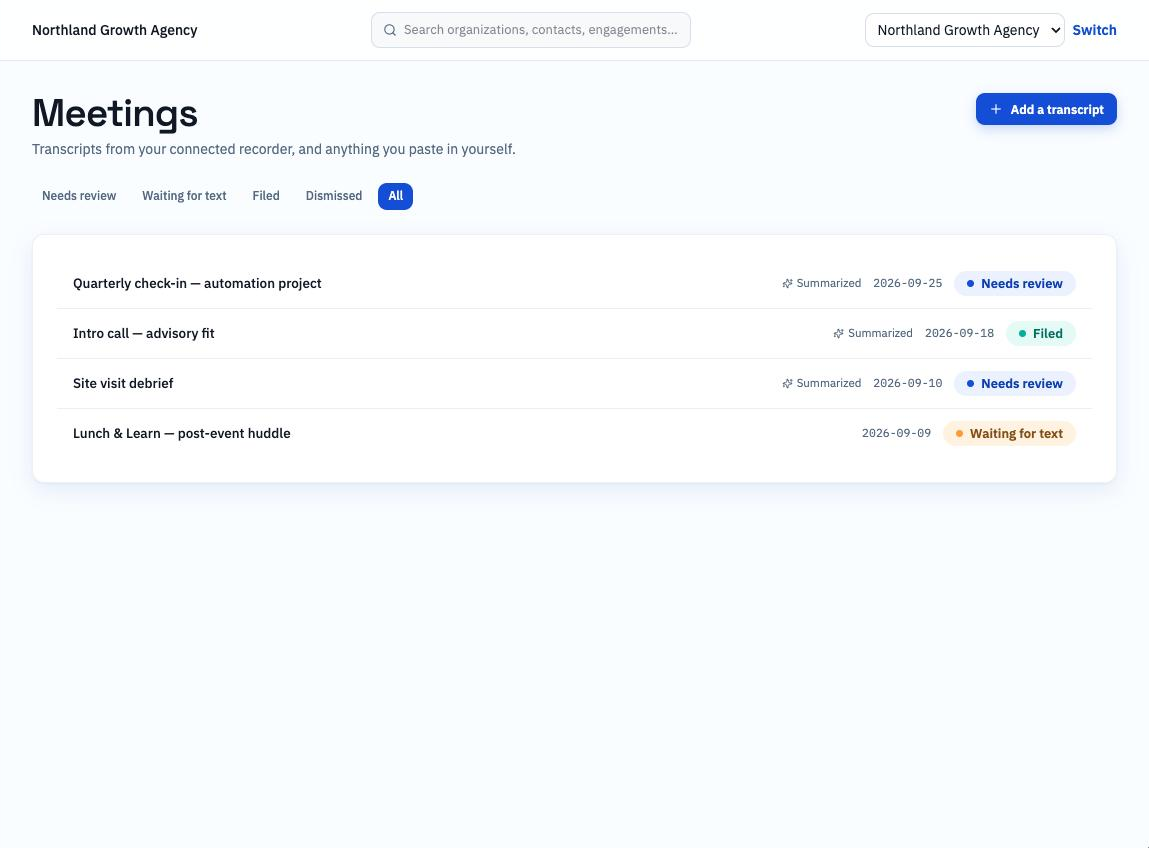
Transcripts arrive from a third-party capture provider. They are kept as evidence, collapsed by default, and are not the artefact.
From transcript to bound context
What happens after a meeting
- 1
The transcript arrives
From your capture provider, after the meeting ends.
- 2
It is bound
To the organization, contact and engagement the meeting concerned.
- 3
A summary is drafted
Through the AI gateway, with a manifest and extracted assumptions.
- 4
A person owns it
Each assumption accepted or corrected by name. Then it can be attached to the file.
Why the transcript is collapsed
On the review screen, the transcript sits collapsed at the bottom, beneath the summary. That is deliberate. A transcript is third-party speech: what an applicant said, word for word, in a conversation they may not have expected to be kept. It is evidence, not the artefact the agency produces. Opening it should take an act of will, and the summary, not the transcript, is what goes on the file.
What this does not do
- StreamBuild does not record meetings. Transcripts come from a separate capture provider, which processes the audio under its own terms.
- A summary cannot be attached to a file until every assumption on it has an owner.
- Transcripts are not edited. Corrections are made to the summary.